
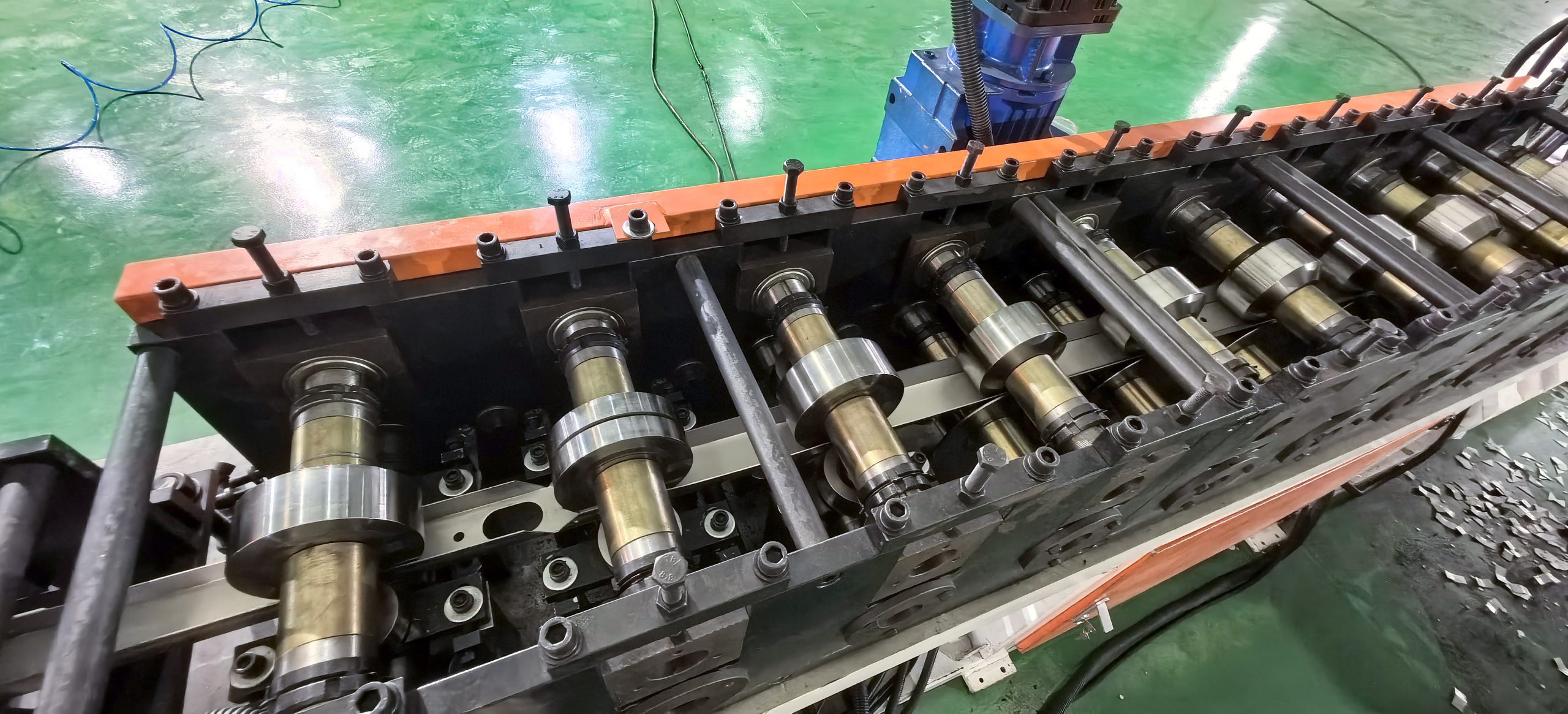
How Custom Roll Forming Lines Reduce Costs and Maximize Efficiency for Global Manufacturers
—— From Your Drawing to High-Volume Production
Introduction
In modern manufacturing, achieving high precision and high efficiency in metal profile production is essential. For industries ranging from construction to shelving and automotive, cold roll forming stands out as one of the most effective methods to transform flat metal coils into complex, high-strength profiles.
Whether you are looking to upgrade your current production line or venturing into a new manufacturing sector, understanding how this technology works and how to select the right equipment is the key to unlocking higher margins and lower operating costs.
What is Cold Roll Forming?
Cold roll forming is a continuous bending operation where a long strip of metal (usually steel, aluminum, or galvanized coils) is passed through a series of consecutive stands, each containing paired rollers.
Instead of hitting the metal once like a press brake, the rollers progressively shape the material, step by step, until the desired cross-section—such as a U-channel, C-profile, Z-purlin, or a highly complex closed section—is achieved. Because the material is formed at room temperature, it retains its structural integrity while gaining increased strength due to work hardening.
Key Advantages of Roll Forming
- High Speed & Efficiency: Once the line is set up, it can produce thousands of meters of continuous profile per hour with minimal waste.
- Unmatched Consistency: Every piece produced is identical, with exact tolerances meeting strict international standards.
- Material Savings: Roll forming minimizes scrap rates, ensuring you get the most out of your expensive metal coils.
- Integrated Processes: Punching, notching, embossing, and cutting can be integrated directly into the forming line, eliminating the need for separate secondary operations.
- High Strength: The process increases the tensile strength of the material, making it ideal for structural applications.
Common Forming Defects and How to Avoid Them
For engineers and production managers, quality control is paramount. The most common issues encountered in roll forming include:
- Flare: Expansion at the ends of the profile, often caused by improper roller alignment.
- Bow & Twist: The profile curves or twists along its length, usually due to uneven stress distribution.
- Buckling: Warping on the flat surfaces of the profile.
How modern equipment solves this: Advanced manufacturing lines utilize precise CNC-machined rollers (such as Cr12MoV steel) and state-of-the-art straightening mechanisms to eliminate these defects. Servo-driven positioning systems ensure that cuts are accurate to within ±0.5mm, guaranteeing perfectly uniform finished pieces.
Application Industries
Because of its versatility, roll forming technology is widely used across the globe:
- Construction & Infrastructure: Metal roofing sheets, wall panels, C/Z purlins, and structural framing.
- Warehousing & Logistics: Racking uprights, step beams, and shelf panels.
- Interior Decoration: U-channel aluminum trim, ceiling grids, and edge trims.
- Automotive & Solar: Chassis components and solar panel mounting brackets.
Why Customization is Crucial for Your Project
Every factory has unique requirements. Standard “off-the-shelf” machines may not fit your specific profile drawings, punching patterns, or production volumes.
As a professional supplier of Chinese manufacturing factories, we do not sell standard machines. We build fully customized production lines from scratch.
Our engineering team analyzes your exact cross-sectional drawings and:
- Designs the specific roll-forming “flower pattern” for your profile.
- Fabricates durable roller dies with vacuum heat treatment for maximum lifespan.
- Integrates customized punching and notching stations exactly where your design requires them.
- Provides a fast die-change system, allowing you to switch between profiles for different orders efficiently.
Our Commitment to Global Buyers
When you partner with us, you gain access to a dedicated international sales and technical support team. We provide:
Reliable Quality: We offer pre-shipment testing, ensuring your custom machine runs perfectly before it leaves the factory.
Free Feasibility Assessment: Send us your CAD, PDF, or even hand-drawn sketches. We will evaluate the project and provide a detailed quotation within 48 hours.
Lifetime Remote Support: Our engineers are available via video call to help with installation, troubleshooting, and operator training.